 Visit Athens Guide
Why the Parthenon Is a Ruin: 1687, Elgin, Balanos
Last reviewed 2026-09-02
Why is the Parthenon a ruin? Almost everybody who walks up the Acropolis assumes the building has been decaying gently for two and a half thousand years. It has not. In the words of the Acropolis Restoration Service — the state body that has been putting the thing back together since 1975 — “the building remained intact in all its perfection for centuries”. It was a temple, then a church, then a mosque, and it was still standing up. What ruined it happened in three bursts, all of them recent by its own standards, and the third one was an attempt to save it. This is the story with the official record separated from the folklore, because a great deal of what is repeated about 1687 is not written down anywhere official. This is a guide post on the Athens city guide; the building's own page is the Parthenon, and the rock it stands on is the Acropolis.
Quick answer Three events, and the surprising third one
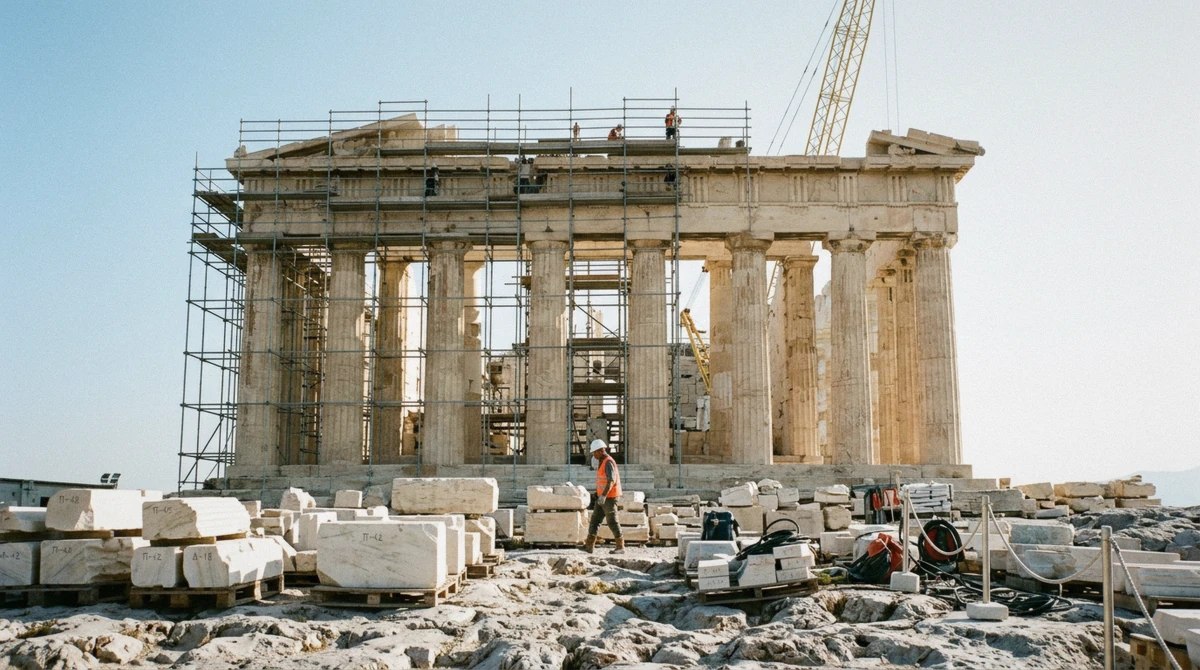
The Parthenon is a ruin because of three things, none of them slow decay. In 1687 a Venetian bombardment set off Ottoman gunpowder stored inside it and the building came apart. In the early 1800s Lord Elgin's men cut sculpture off what was left. And between 1896 and 1933 a Greek restoration reassembled it using iron clamps that rusted, expanded and split the marble from the inside — which is most of what the cranes on the rock are undoing today.
Key takeaways
- It stood almost whole until 1687 — as a temple, a church and then a mosque.
- The explosion is the one certain date; the casualty figures people quote are not in the official record.
- Elgin removed 18 pedimental statues, 15 metopes and 56 blocks of frieze — those are the Restoration Service's own numbers.
- The 20th-century repair did the third round of damage, and undoing it is the current work.
- The cranes you see are the west pediment, under way since June 2017.
It Stood Almost Whole for Two Thousand Years
The building's first two millennia are a story of changing use, not of collapse — and its survival is precisely because it kept being useful.
Built in eleven years, finished in fifteen
Construction ran from 447 to 438 BC, with the pedimental sculpture completed a few years later, in 432 BC. Eight columns at each narrow end, seventeen along each side, designed by Iktinos and Kallikrates with Pheidias supervising the sculpture. Inside stood Pheidias's gold-and-ivory Athena, and from 433 BC the west chamber held the public funds of the city — the temple was also the treasury.
All of this comes from the Acropolis Restoration Service's own description of the monument.
Fire, then a church, then a mosque
In late Roman times the building suffered serious fire damage and was repaired in the fourth century AD, probably under the emperor Julian. Shortly after, it was altered to work as a church, and in 1205 it was dedicated to the Holy Mother of Athens. Athens fell to the Ottomans in 1460, and a few decades later the Parthenon was converted into a mosque — the stairway built into the south corner during the Latin occupation became the minaret.
Through every one of those conversions the structure itself held.
Which is the point worth carrying up the hill
Standing at the gate looking at the gaps, it is natural to read them as age. They are not. Twenty-two centuries of Athenian weather, earthquakes, empires and religions did less to this building than three human decisions taken in the last three hundred and forty years.
That is the story the visit does not tell you, because there is no sign on the rock that says it.
1687: The Certain Part and the Folklore
This is where a travel guide has to be careful, because the internet's version of this night is far more detailed than any official source will support.
What the official record says
The Acropolis Restoration Service puts it in two sentences: “The greatest catastrophe in the entire history of the temple occurred in 1687 when it was bombarded during the siege of the Acropolis by the Venetians. The explosion of the gunpowder that the Turks had stored within the monument caused extensive parts of the temple to collapse and turned the monument into a ruin.” That is the whole of it, from the body responsible for the building. A Venetian army besieging the Acropolis; an Ottoman garrison using the temple as a powder magazine; a shell; the roof and the long walls gone in a moment.
What is repeated everywhere but is not in that record
The date is usually given as 26 September 1687, and the commander as Francesco Morosini. Casualty figures circulate widely — three hundred is the number you will see most often, sometimes with the detail that the garrison had moved families into the temple believing the Venetians would not fire on it. None of those figures appears in the Restoration Service's account, and we have not found them in a primary published record we could cite. They may well be accurate.
We are simply not going to print them as though they were established, on a page whose whole method is to say where a number came from.
The horses, which we also cannot vouch for
The best-known coda to the night is that Morosini then tried to lower the horses of Athena and Poseidon from the west pediment as a trophy, that the tackle failed, and that the sculptures shattered on the rock. It is a widely repeated account and it is not mentioned on the Restoration Service's page at all. Treat it as tradition rather than as record — which, given what the west pediment is going through right now, is a characteristically Athenian irony.
What actually came down
The official phrasing is “extensive parts of the temple”, and standing in front of it you can read which parts: the roof, the long side walls of the cella, and the columns of the flanks in the middle stretches. The two short ends, east and west, survived best, which is why the building still reads as a temple from the ends and as a quarry from the sides.
1801–1812: The Numbers the Restoration Service Publishes
The second round of damage has exact figures, and they come from the Greek state's own restoration body rather than from a campaign group.
Eighteen, fifteen, fifty-six
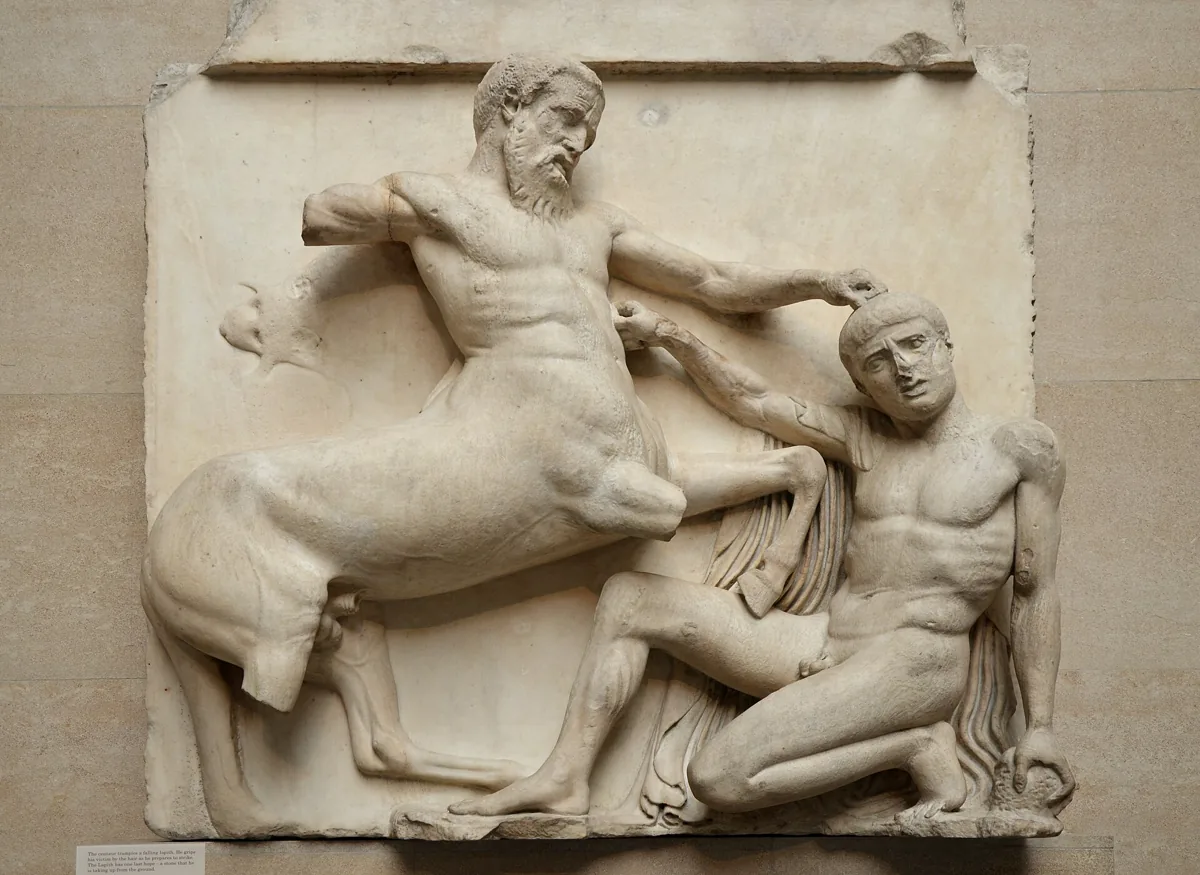
The Acropolis Restoration Service writes that the picture of destruction “was completed during the 19th century with the systematic removal of the sculpture of the temple by Lord Elgin”, and gives the tally: eighteen pedimental statues, fifteen metopes and fifty-six blocks of the Ionic frieze were — their word — ‘ruthlessly severed’ from the Parthenon. Those pieces are in the British Museum. It is worth knowing that the official Greek phrasing is that blunt, because the language on the rock and in the museum is far more measured than the language in the technical documentation.
Why this changes what you see in two buildings
It is the reason the Acropolis Museum is laid out the way it is. The top floor is built to the Parthenon's own dimensions and orientation, with the surviving frieze blocks in their true positions and plain casts standing in for the ones in London — so the gaps are the exhibit. And it is why the Caryatids you see on the Erechtheion porch outside are copies: five originals are in the museum, one is in London. Rock or museum first argues the order.
1896–1933: The Repair That Did the Damage
The least-known of the three, and the one that has occupied the last fifty years of work on the building.
Nikolaos Balanos, and iron
The Restoration Service names the landmark: “the restorations carried out by N. Balanos during the years 1896-1902 and 1923-1933”, which “have given the monument its present appearance”. Balanos re-erected fallen columns and blocks and pinned them together with iron clamps and dowels. Iron in marble in an Athenian climate does one thing: it oxidises, and rust occupies more volume than the metal it came from.
The clamps swelled inside their sockets and split the blocks they were holding — from the inside, invisibly, for decades.
And glue
The Service's own account of opening up the west wall is unsparing about what it found: fractures in the blocks of all three lower rows, “extensive chiseling off” of original marble, and “inappropriate materials (Meyer stone glue)” used in the older intervention. This is a state body describing an earlier generation of its own profession, in a public document, in those words.
Titanium instead
Everything reassembled since 1975 uses titanium, which does not corrode, together with new Pentelic marble cut to fill losses. That is the whole logic of the modern work: take the building apart where Balanos touched it, remove the iron, restore the fractured blocks and put them back with metal that will not do it again. It is why a restoration that began in 1975 is still going, and why it looks so slow to a visitor who assumes the job is ‘rebuilding the Parthenon’.
It is mostly undoing.
What the Cranes Are Doing While You Are There
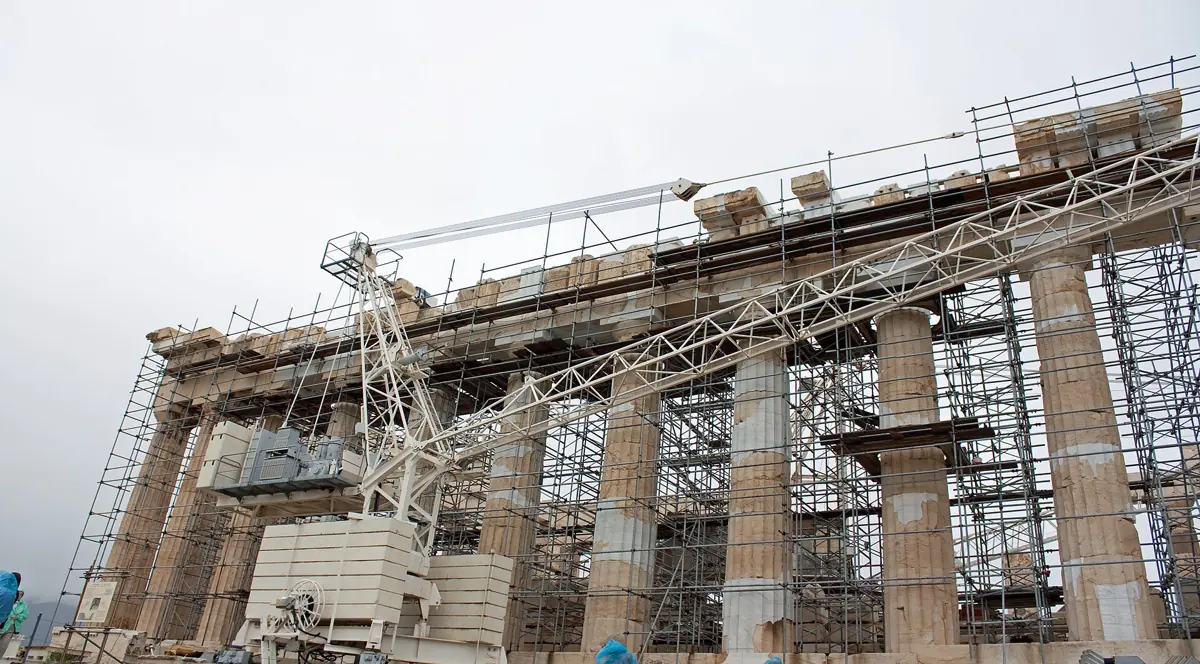
The scaffolding is the single most complained-about thing on the rock. It helps to know precisely what it is for.
The west pediment, since June 2017
The current programme concentrates on the west pediment and the side walls of the cella. Work on the west pediment began in June 2017 and the Restoration Service describes it as having “a rescue character”: removing the oxidised clamps of the Balanos intervention, conserving and reinforcing the architectural members, and correcting the distortions in the orthostat blocks, which had “the most serious static problems” of anything on the building. Three middle blocks of the tympanum were dismantled, structurally restored and put back; a fourth was reinforced in place.
So the west front is the one to look at
If you come up through the Propylaea you meet the west end first, and that is currently the working face of the monument — which is either the disappointment of the visit or the most interesting thing on the rock, depending on whether you know what you are looking at. From Philopappos Hill, free and ten minutes away, you get the long south flank instead, which is the side the explosion opened.
There is no finish date, and that is not evasion
Every phase is funded and approved separately, studies are published per element, and the work is deliberately reversible. Nobody publishes a completion year for the Parthenon because the concept does not apply. If you want the state of play before you go, the Acropolis Restoration Service publishes its ongoing interventions monument by monument at ysma.gr — the same source every fact on this page came from.
Questions About How It Was Ruined
What happened to the Parthenon in 1687?
A Venetian army besieging the Acropolis bombarded it, and a shell reached the gunpowder the Ottoman garrison had stored inside the temple. The explosion brought down the roof, the cella walls and much of the flanks. The Acropolis Restoration Service calls it “the greatest catastrophe in the entire history of the temple”.
How many people died in the 1687 explosion?
No figure appears in the official Greek record of the monument, and we do not print the numbers that circulate elsewhere. What the Restoration Service states is the damage to the building, not a casualty count.
How much of the Parthenon sculpture is in London?
The Acropolis Restoration Service records that eighteen pedimental statues, fifteen metopes and fifty-six blocks of the Ionic frieze were removed by Lord Elgin. They are in the British Museum; the surviving pieces in Athens are on the top floor of the Acropolis Museum, with casts marking the absences.
Why is there always scaffolding on the Parthenon?
Because the restoration is mostly the reversal of an earlier restoration. The iron clamps used between 1896 and 1933 rusted and cracked the marble, and every block affected has to be taken down, repaired and rebuilt with titanium. The current phase, on the west pediment, has been running since June 2017.
Can you go inside the Parthenon?
No. There is no interior left to go into and the building is a working restoration site; visitors circulate around it on the rock. What the €30 ticket covers is on the Acropolis tickets page.